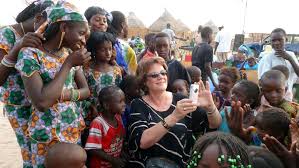
Being part of this transformative grassroots movement across
Africa is the culmination of my life experience. My diverse career in
journalism, my endless studies in psychology and my decades of devotion to raising
children has steered me along a meandering track but now I’ve returned to my
core values and quite possibly the work I was born to do.
The prospect of living with the purpose of improving the
quality of life for the poorest of the poor fills me with joy, love and
empowerment. Ever since I was an idealistic university student in my early 20s,
the struggle for human rights and social justice lit a fire in my belly. In my
feisty youth I was enraged and pained by the unfairness of inequality, poverty,
cruelty and suffering.

A Celebration of Diversity
What a colourful mixture of cultures we are and yet we are united by a passion to make a difference.
We’ve all come to this large round room, styled on an
African thatch-roofed hut, at the impressive training centre and accommodation based in Thies, the fourth largest city of Senegal in West Africa, two hour’s sultry drive
from the bustling capital of Dakar to be trained in the Tostan method of
community-led development.
“Tostan” in the local language of Wolof is an evocative word
meaning “breakthrough”, the breaking of an egg, when the little chick emerges
to start a new life. This unique program has been the catalyst for spreading
transformation, indeed giving hope and new life to a multitude of resource-poor communities.
The dynamic organisation is celebrating its 25th
anniversary this year, bringing education about health and human rights to
hundreds of remote villages throughout West Africa, transforming life for
millions of women, men and children.
The fertile seeds of knowledge have miraculously sprouted
life-enhancing projects in food production, clean water and sanitation,
healthcare, schools, solar power and income-generating projects such as tie-dying
fabric, soap making, poultry farming and the greatest achievement of all,
ending the harmful practice of female genital cutting (FGC) and child marriage of precious young
girls.

Tostan Founder and CEO, Molly Melching is a pioneer with the rare combination of strength and tough determination mixed with the softness of empathy and compassion that comes from years of witnessing gruelling hardship and brutal deprivation and misery.
An America raised in the conservative midwestern state of Illinois,
Molly, as an adventurous 24 year old exchange student landed in Senegal in 1974
for a six month stint of studying African Literature at the University of Dakar. That was
42 years ago and she’s still living in her beloved Senegal, with
a fierce devotion to the Senegalese people.
Devotion to A Cause
Her devotion to Senegal led Molly to master both fluent French and the traditional language of Wolof and immerse herself in the culture by living in impoverished villages and truly understanding the people and their needs and aspirations through a process of non-judgmental, respectful “deep listening”.
She came to understand that ignorance, or simply a dire lack
of basic information, was at the root of so much unnecessary suffering. Without
scientific explanations in their own language, villagers often attributed the cause of sickness, death and
misfortunes to “bad spirits”.
She also realised that knowledge is the key to empowerment;
specifically knowledge about health, anatomy, hygiene and germ-transmission, child
development, human rights, problem solving, conflict resolution and good governance.
Through her many years of patient, compassionate listening
to the locals’ heartfelt values, yearning aspirations and deep desire for
community wellbeing, Molly developed a comprehensive (some 2000 pages)
education program to be taught by local village facilitators in their own language
spread over three years.
While other well-meaning charities, NGOs and government
agencies have often swept into poor communities, identified needs and imposed solutions,
which were doomed to fail, Molly’s radical approach was to empower villagers
with essential knowledge and allow them to join the dots, make their own
connections, experience the thrill of light bulb moments and discover for
themselves their needs and solutions. And the approach worked!
Tostan’s transformative Community Empowerment Program (CEP) has
been so successful, it’s attracted funding and support from UNICEF, UNFPA, the Bill
and Melinda Gates Foundation, the Carter Center, Hillary Clinton, the London-based Orchid Project and
hundreds of loyal donors. The program's been scrutinised by curious academics, monitored
and evaluated and won numerous prestigious awards including the Conrad N. Hilton Humanitarian Prize for "extraordinary contributions toward alleviating human suffering."
Rocket Launcher for Social Change
Once we human beings know profound truth, we can’t ‘unknow’ it and
knowledge becomes the rocket launcher for unstoppable social change. With
Tostan’s guidance, village participants organised themselves into Community Management
Committees (CMC) with enthusiastic elected representatives (over half of whom are women)
meeting regularly to discuss problems and initiate creative projects. Village
reps also began gathering at monthly regional meetings that have now become a
political force.
 During our training CMC members joined our circle to share
their experiences. The women, resplendent in their beautiful African dresses
and headscarves, were once shy and silent and now travel by horse and cart from
village to village as dynamic awareness-raising activists and respected leaders in their
communities. We were also honoured to listen to a respected Imam explain how FGC is not condoned by the Muslim faith.
During our training CMC members joined our circle to share
their experiences. The women, resplendent in their beautiful African dresses
and headscarves, were once shy and silent and now travel by horse and cart from
village to village as dynamic awareness-raising activists and respected leaders in their
communities. We were also honoured to listen to a respected Imam explain how FGC is not condoned by the Muslim faith.
We were delighted to visit two villages in the district that
have been working with Tostan for several years: the Village of Keur Simbara
and Keur Thiem Saware.


For someone like me who usually sits in a workshop passively listening to the instructor and scribbling notes, I was gently pushed out of my comfort zone to brainstorm and perform on the spot but what a powerful way to learn! I've absorbed the knowledge deeply into my whole being, anchored by positive memories.
In between sessions we enjoyed scrumptious traditional meals served by elegant Senegalese ladies in the cool, spacious dining room where the effusive conversation bubbled over the spicy dishes as we shared stories and ideas!

A Plan of Action
On the final day we all
presented our action plans to the group. I teamed up with lovely Millicent, an
experienced nurse and midwife from Kenya, and together we created a vision for
bringing the Tostan Empowerment Program to the remote rural communities where
she lives. I will be writing much more about this exciting project over the
coming months. Stay tuned!
In the Gratitude Circle the
hugs of affection between everyone were genuine and heartfelt and tears of love
and appreciation flowed freely.


Pure Joy
By the time the farewell dinner celebration came around, we had all bonded and become good friends. Wearing our colourful African boubous and khaftans, each of us in turn danced across the hall with sheer exuberance and elation to music from our country of birth to receive certificates from Molly and Birima. Young Daniel and I busted some very unusual moves for Australia!

My new sister Nomcebo presented me with a stunning traditional shawl from Swaziland and I gave here a pretty floral plate and chocolates from the little English village of Tenterden!


An Inspiring Mentor
And spontaneously, as a fitting finale, our impromptu ‘African Women’s Choir’ sang a rousing verse of You Raise Me Up to Molly Melching, a fearless champion of social change, who has become our inspiring hero, empowering us all to take the transformative Tostan program and principles of human rights to poor communities everywhere.

You raise me up so I can stand on mountains
You raise me up to walk on stormy seas
I am strong when I am on your shoulders
You raise me up to more than I can be.